The tenth Sustainable Development Goal calls on countries to adapt their policies and legislation in order to increase the incomes of the poorest 40 per cent of the population and to reduce wage inequalities based on gender, age, disability, social or ethnic origin, or religious affiliation. This is to be achieved in particular by promoting the representation of developing countries in global decision-making processes.
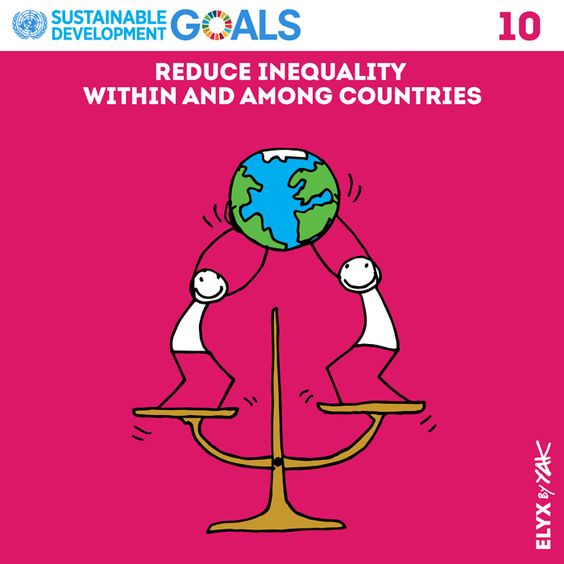

SDG10 - Reduce inequality within and among countries
Where does France stand ?Retour au sommaire
Domestic challenges Retour au sommaire
France benefits from a legal system that protects human rights and a recognised system for redistributing wealth in order to combat inequalities between individuals. However, inequality is a key issue in France.
Inequality is particularly significant in overseas France, especially in terms of access to education, employment, training and health.
Inequality is measured in relation to France as a whole, but also between the territories themselves. These inequalities vary from one region to another, depending on their specific demographic, geographical, sociological and cultural features. The Ministry for Overseas Territories is working with other ministries to combat these inequalities by adapting public policies to specific local circumstances.
In terms of equal opportunities, the correlation between academic performance and socio-economic backgrounds remains high. Dignity and representation of the most disadvantaged are also challenges for France.
For example, the law of 24 June 2016 aimed at combating discrimination on the grounds of social insecurity recognises a new discrimination criterion in French law. This is discrimination against a person on the grounds of their particular vulnerability resulting from their economic situation, whether apparent or known to the perpetrator.
With an increase in discriminatory threats according to the DILCRA, the fight against discrimination is still topical, as illustrated by the new National Plan to Combat Racism, Anti-Semitism and Discrimination on Grounds of Origin (2023-2026).
The legalisation of same-sex marriage in 2013 opened up new rights for gay people, in the name of equality and shared freedoms.
Finally, with regard to migration management, France is involved in supporting host countries, in the political stabilisation of countries in crisis and in managing the migratory crisis caused by the influx of refugees into Europe. The care and integration of migrants remains a challenge for the years to come.
11.2% of young people aged 16 to 25 have reading difficulties in mainland France; this figure rises to 55.7% in Mayotte, 51.8% in French Guiana, 28.9% in Martinique, 30.4% in Guadeloupe and 26.4% on Reunion Island (Ministry of National Education, 2022).
France’s actionsRetour au sommaire
Several national policies and measures contribute directly to SDG10. The list below, by way of illustration, is not exhaustive.
- All establishments open to the public must be made accessible to people with reduced mobility, or face the penalties described in the Order of 26 September 2014.
- The second five-year plan for Housing First (2023-2027) is organised around 3 areas: Produce and mobilise appropriate and affordable housing solutions; Strengthen housing upkeep; Accelerate access to housing and offer support pathways by combining housing, employment and health.
- The fight against illiteracy led by the National Agency to Combat Illiteracy with actions adapted to overseas territories.
- Combating social and territorial inequalities in access to healthcare through the 2018-2022 National Health Strategy. Specific measures have been defined for the overseas territories. A new strategy is currently being developed.
- The 2nd chance schools were created to offer a solution to the 100,000 to 130,000 young people who leave the school system each year without a certificate or qualification and find it difficult to enter the world of work. E2C students are motivated young people who have chosen to seize a second chance to build a future for themselves, thanks to bespoke support. The network’s 146 school sites welcome 15,000 young people every year.