The eleventh objective aims to rehabilitate and plan cities, as well as other human settlements, in such a way that they can provide everyone with employment opportunities and access to basic services, energy, housing, transport, green public spaces and other amenities, while improving resource efficiency and reducing environmental impacts.
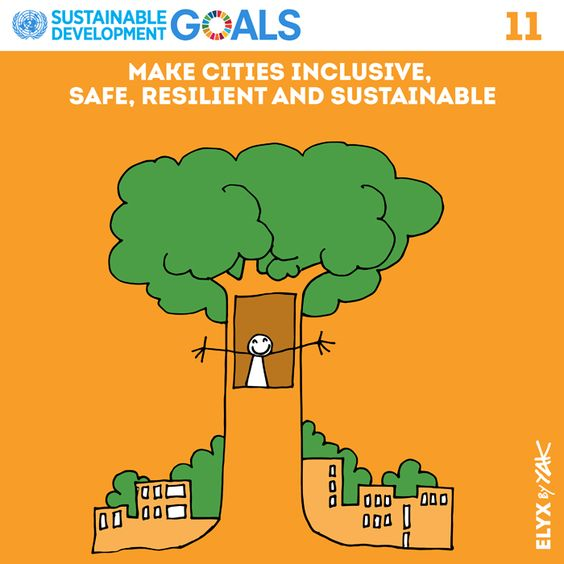
SDG11 - Make cities and human settlements inclusive, safe, resilient and sustainable
Where does France stand ?Retour au sommaire
Domestic challenges Retour au sommaire
While urban growth continues at a high rate in the form of expansion towards the outskirts, the development of more sustainable towns and cities is a major challenge if we are to improve residents’ quality of life (housing, mobility, services), ensure the momentum of economic activities and limit land take, the consumption of resources and the deterioration in the quality of air and the environment.
In order to respond as broadly as possible to the SDGs, two priority challenges have been identified with major implications for cities and regions:
- Succeed in the ecological and energy transition, by adapting all planning measures, promoting built and natural (landscape, nature and biodiversity) heritage, but also by developing two major sectors: construction and transport.
- Strengthen regional cohesion, by ensuring access to housing for all and better integration of disadvantaged neighbourhoods and vulnerable populations into towns and cities and inventing a new balance between rural areas and small, medium-sized and large cities.
France’s actionsRetour au sommaire
An ambitious reform of town planning has been carried out, increasing the role of local areas and integrating all sustainable development issues into planning documents. The regional plan for land use, sustainable development and territorial equality (SRADDET) enables regions to build a vision for the future with all local players, and to work more closely with European regions. Intercommunal local urban plans (PLUi) enable French administrative structures (communes or multiple communes) to work together to develop a broader vision for the development of their region, integrating, at the appropriate level, issues relating to town planning, housing, transport and economic activities.
Regarding access to housing, the Enforceable Right to Housing (DALO) was introduced in 2008. After the 2014 rehousing assistance plan, the 2014 law on access to housing and renovated town planning and the 2017 equality and citizenship law contain provisions to make this right more real. Between 2008 and 2020, 333,848 households were recognised under DALO. 207,399 of them were granted access to housing, i.e. 62% of all households. 77,684 households recognised as having priority are still waiting for housing and have been for between 1 and 13 years.
In order to rethink sustainable town planning, a National Strategy for Architecture has been put in place, the framework of which has been clarified, adapted and strengthened by the law on freedom of creation, architecture and heritage. It has been designed around six themes: communication about architects and architecture, France’s architectural heritage, education and research, architectural skills, the economic value of architecture and promoting the experimental approach. The 2023 National Architecture Days were organised on the theme of ecological transition.
On biodiversity issues, the law of 8 August 2016 for the Restoration of Biodiversity, Nature and Landscapes sent a message of mobilisation to all territories, businesses and local authorities to encourage them, through updated tools, to take action to protect our natural heritage.
To this end, France has set a target of "zero net land take" by 2050. Urban sprawl in particular can be curbed by targeted densification and town planning initiatives, such as the “Action Cœur de Ville” (City Centre Action) Programme, which the French government has been supporting for 222 towns and cities since 2017.
The 2021 Sustainable Cities and Innovative Buildings Strategy is part of the "Living in the France of Tomorrow"approach. Its three strategic priorities are:
- Accelerating the transition of cities through a necessary integrated approach,
- Action on buildings to reduce energy consumption,
- Supporting the development of sectors.
An Energy Renovation Plan for Buildings was launched in 2018 to speed up the fight against global warming. Major home renovation is also seen as the main way of helping households out of energy poverty. The MaPrimeRénov’ scheme, which has been open since 1 January 2020, has become the State’s main form of support for energy renovation, and was stepped up in 2023.
The Mobility Conferences held in 2017 identified the priority needs and expectations of all citizens in terms of mobility. The outcome was a new Mobility Orientation Law, which was passed in December 2019. It radically transformed mobility policy, with a simple objective: everyday transport that is easier, cheaper and cleaner.
The national housing strategy is supported by the law on changes in housing, land development and digital technology (known as the Elan law) of 23 November 2018. It provides concrete and operational solutions focusing on four key areas: building better and more cheaply; restructuring and strengthening the social housing sector; promoting social diversity and improving living conditions.
The relaunch of an inclusive urban policy covering all areas of neighbourhood life will enable disadvantaged neighbourhoods to be better integrated into cities. It will complement the ongoing €75 billion National Urban Renovation Programme.